
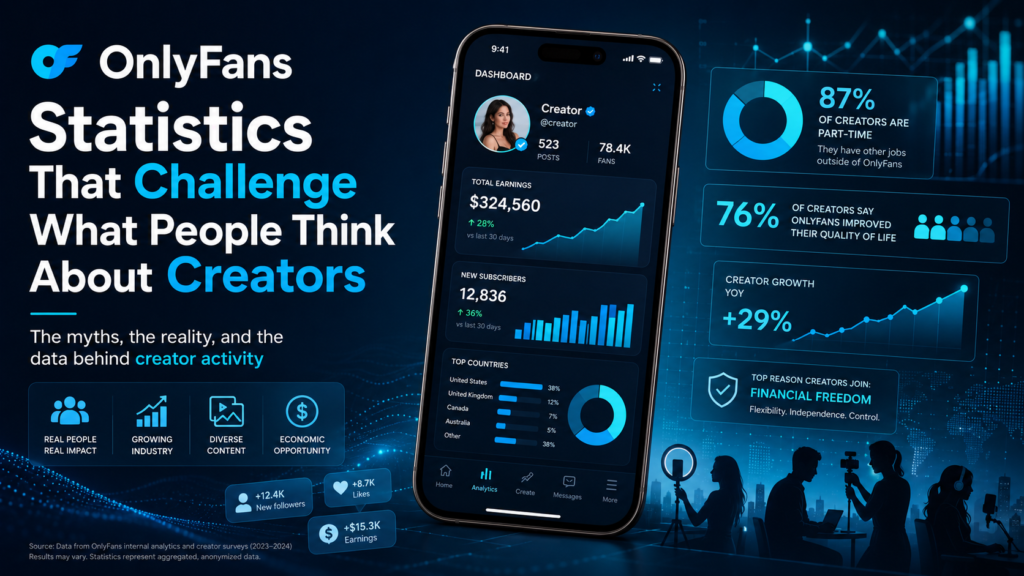
OnlyFans is usually discussed through extremes. Some people see it as easy money. Others only talk about the biggest creators, viral stories, or controversies. But when you look at public creator data, the reality is much more complicated.
FansPedia, an OnlyFans finder and discovery platform, analyzed publicly available information from more than 1,000,000 creator profiles. The data includes public profile signals such as subscription pricing, account activity, posting frequency, visible engagement, free vs paid account type, and whether profiles remain publicly available over time.
The first surprise is that many creators do not stay active for long.
Across the dataset, around 42% of creator accounts show no meaningful public activity within 90 days of creation. That suggests a large number of people start an account, test the platform, and stop when they realize how much work is required.
OnlyFans may be easy to join, but it is not easy to maintain. Creators need to post consistently, promote themselves, answer messages, test pricing, manage boundaries, and keep audiences interested. For many, the workload appears to be much higher than expected.
Another surprising pattern is pricing.
A common assumption is that higher-priced creators must be more popular. FansPedia’s data does not support that. Across the dataset, the correlation between subscription price and follower count is only r = 0.04. In plain terms, price and popularity barely move together.
This means a creator charging $25 per month is not automatically more successful than someone charging $7 or $10. Attention comes first. Pricing only matters after a creator has built visibility, trust, and demand.
The data also challenges the idea that free OnlyFans accounts are less serious.
FansPedia found that 68% of free-tier accounts post more frequently than paid-tier accounts in the same content category. This makes sense when you look at free accounts as a marketing funnel. A creator may use a free profile to attract followers, build reach, test content, and later monetize through tips, paid messages, bundles, custom content, or premium offers.
In other words, the free page is not always the product. Sometimes it is the entry point.
Deleted and abandoned accounts are also part of the story. Many public profiles become unavailable over time, either because they are deleted, hidden, renamed, restricted, or abandoned. This “vanishing creator” layer is important because most public coverage focuses only on success stories, while the inactive and disappeared profiles show how difficult the creator economy can be.
The money side is also uneven. OnlyFans as a platform has grown into a multi-billion-dollar subscription business, with millions of creators and hundreds of millions of users worldwide. But that does not mean most creators are making large amounts of money. Like most creator platforms, attention and earnings appear heavily concentrated among a smaller group of consistent, visible, high-engagement creators.
Another interesting pattern is geography. Many people assume that the creator economy is dominated only by major cities such as Los Angeles, Miami, London, and New York. But FansPedia’s data suggests smaller markets can still compete. Creators from smaller countries and cities often show strong activity when they are consistent, niche-focused, and discoverable.
The bigger lesson is that OnlyFans is not just an adult-content platform. It is a case study in modern online work.
Creators are not only performers. They are also marketers, pricing strategists, content planners, customer-service managers, and audience-retention teams. The platform gives creators direct monetization tools, but it does not remove the hard part: getting found and staying active.
The myth is that OnlyFans is easy money.
The reality is that OnlyFans reveals how demanding the creator economy actually is.

Say Job City in Pakistan for today latest jobs opportunities in private and Govt departments. View all new Government careers collected from daily. sayjobcity.online